Etched and published by John Hamilton Mortimer (May 20, 1775)
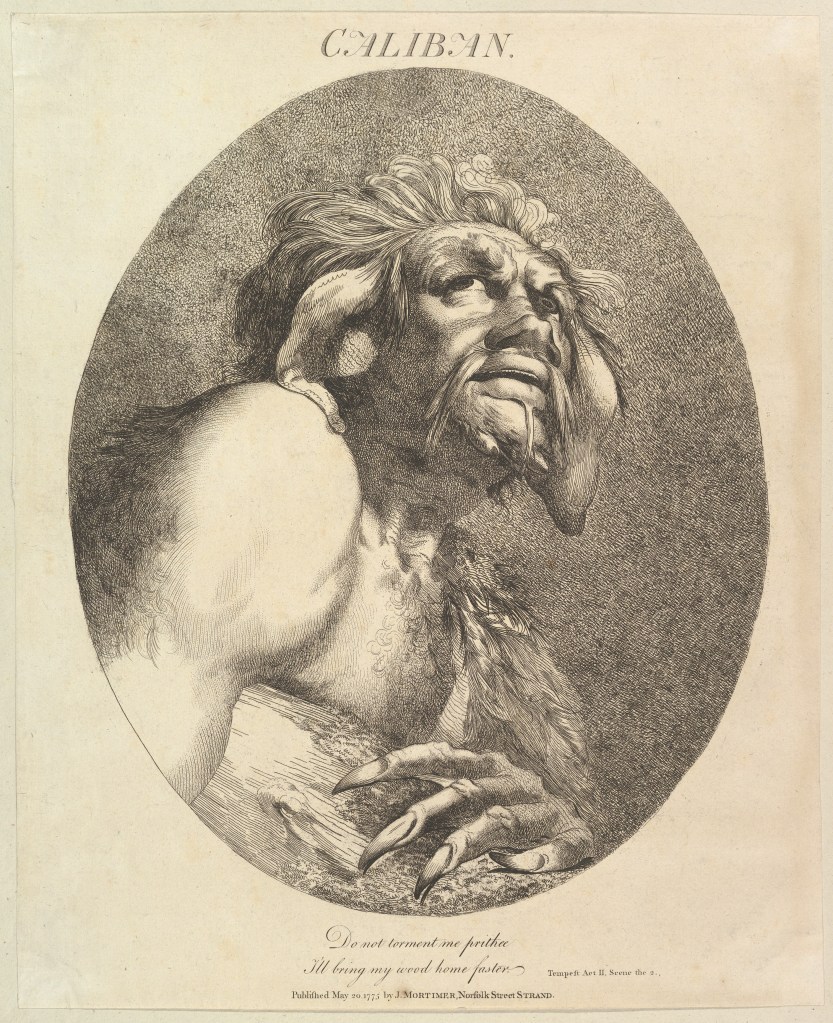
“Do not torment me prithee
I’ll bring my wood home faster.”
(The Tempest, act 2, scene 2)
This is a beautiful image of Caliban that poignantly relays a message rather similar to the one that Buchel’s Caliban raises.
Similarly to Buchel’s Calban, Mortimer’s Caliban looks less than human. He is faun-like, a creature that I would expect out of mythology. He has the big droopy ears and long clawed fingernails. His right shoulder seems to be covered in hair, or even feathers. Yet, his torso and human expression are so human in their fear, they elicit sympathy.
I would suggest that the goal of this etch was to create sympathy for Caliban. The quote underneath his image makes the objective blatant, as it is a plea to not torment Caliban. This is again aimed toward Prospero, and the way that Caliban’s body is stopped, with his clawed hand held toward his body and curled in, denotes real fear. He is not intimidating or savage. He is a non-human, yes, but one deserving of sympathy. The poetry in this Caliban lies in the human expression on an otherwise non-human creature, one who is being hurt by someone he feels is more powerful than himself. If Buchel’s Caliban raised the question for me if Caliban was truly a monster, then Mortimer’s Caliban seems to answer that question. He is not a monster. He is not a human, but he is also not monstrous.
 Poetry of Caliban