From novel Miranda and Caliban by Jacqueline Carey
Book Description
We all know the tale of Prospero’s quest for revenge, but what of Miranda? Or Caliban, the so-called savage Prospero chained to his will?
In this incredible retelling of the fantastical tale, Jacqueline Carey shows readers the other side of the coin―the dutiful and tenderhearted Miranda, who loves her father but is terribly lonely. And Caliban, the strange and feral boy Prospero has bewitched to serve him. The two find solace and companionship in each other as Prospero weaves his magic and dreams of revenge.
Link to novel: https://www.goodreads.com/book/show/25670396-miranda-and-caliban
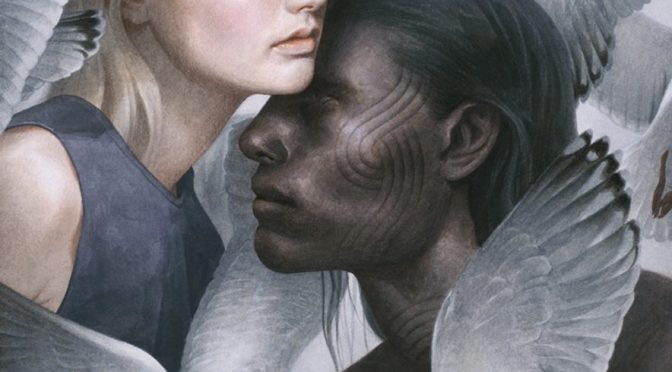
Fittingly for a visual representation on a YA romance novel, the beauty, or “poetry”, of this Caliban is in his face. This illustration of Caliban is pointedly different from the other two images of Caliban by Buchel and Mortimer. In those portrayals, Caliban is depicted as a decidedly non-human creature who has a compelling expression befitting of humanity. Here, Caliban seems to be completely human physically – with facial carvings that only slightly set him apart as “other.”
Jacqueline Carey’s Caliban is mutually in love with this story’s Miranda, and we are told immediately in the book’s summary that Caliban is a “so-called savage.” In tangent with his good looks on the cover and that self-aware “so called” title, I can assume that this Caliban is explicitly considered misunderstood, rather than subtly so like with Shakespeare’s Caliban.
However, while his outer appearance (on the cover art) might seem human, his manner is said to be “feral” and “strange.” Ironically, Shakespeare’s Caliban is able to outwardly express the poetry that marks him as a sympathetic man despite his (we are told) monstrous appearance, while Carey’s Caliban looks rather normal on the outside, but is suggested to act externally different. While Shakespeare’s Caliban is perceived to be monstrous, but perhaps underneath his exterior, is quite human, Carey’s Caliban is more like a human who is, wrongfully, perceived to be monstrous.
 Poetry of Caliban