Natural Theology of the Island
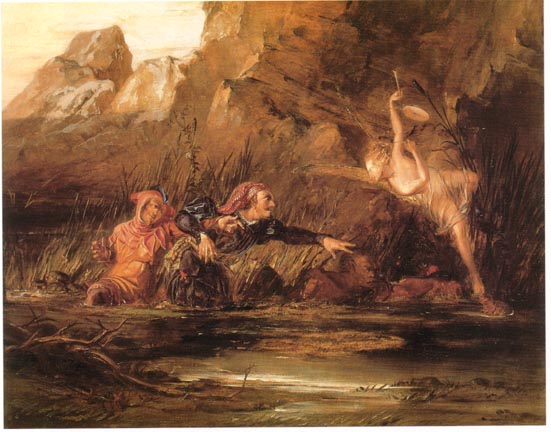
“Thou thoughtest that I was altogether such a one as thyself.”
(David, Psalms 50.21)
[‘Will sprawl, now that the heat of day is best,
Flat on his belly in the pit’s much mire,
With elbows wide, fists clenched to prop his chin.
And, while he kicks both feet in the cool slush,
And feels about his spine small eft-things course,
Run in and out each arm, and make him laugh:
And while above his head a pompion-plant,
Coating the cave-top as a brow its eye,
Creeps down to touch and tickle hair and beard,
And now a flower drops with a bee inside,
And now a fruit to snap at, catch and crunch,—
He looks out o’er yon sea which sunbeams cross
And recross till they weave a spider-web
(Meshes of fire, some great fish breaks at times)
And talks to his own self, howe’er he please,
Touching that other, whom his dam called God.
Excerpt above. Link to full poem: https://www.poetryfoundation.org/poems/43748/caliban-upon-setebos
Robert Browning’s “Caliban Upon Setebos” begins with a bible verse. Specifically, one where God criticizes wicked people for thinking Himself wicked like they are. Browning’s Caliban, the speaker of this poem, seems to make the same claim that he too is different from how he is perceived to be – different from what Setebos, Caliban’s god, may think, but also different from who Prospero thinks he is.
Browning’s Caliban, like Shakespeare’s, depicts several contrasting characteristics. His pose in the beginning of this poem is rather childlike – lying on his stomach, kicking his legs up and down. He even refers to himself in the third person throughout the piece. Yet, his thoughts are surprisingly complex. He is considering his creator, Setebos, theorizing about the ways in which Setebos operates and how he himself should respond. As the secondary title of this poem suggests, Caliban is pondering theology, a topic rather at odds with his child-like posture.
What continues to surprise me in this poem is also how Caliban can think simply at times and yet be deeply observant. For instance, he dances only at night, so Setebos won’t be able to see him be happy, lest Setebos choose to bring misery to him. Caliban has a sort of wicked satisfaction in his own cleverness, but reveals himself to actually be deeply attuned to life on the island through his beautiful descriptions of it:
Yon otter, sleek-wet, black, lithe as a leech;
Yon auk, one fire-eye in a ball of foam,
That floats and feeds;
The contrasting character of Browning’s Caliban is carefully depicted in the form of a poem that Browning has Caliban himself deliver. And like Shakespeare’s Caliban, this evokes the image of a character that is sometimes strange and “other”, but perhaps much more sensitive and astute than he is given credit for. Only through his poetry do we see that perhaps he is more than he is thought to be.
 Poetry of Caliban