Featured

An Introduction

This blog performs an investigation of Caliban, a main character from Shakespeare’s The Tempest. Caliban is a man of many contradictions. In Act 1 scene 2, he is introduced to as a “poisonous slave”, of a “vile race” and as “hagseed.” Other characters also remark on his appearance and demeanor, describing it as monstrous, yet the reader/audience is also briefly shown a different aspect of Caliban: one that is sensitive, articulate, intelligent. We see his poetry.

Perhaps one of the most famous, and beautiful, quotes by Caliban comes at a moment where he is lowering himself before Stephano and they both suddenly hear the invisible Ariel play music. Caliban asks if Stephano is afraid, and when Stephano denies that he is, Caliban says:

Be not afeard. The isle is full of noises,
Sounds, and sweet airs, that give delight and hurt not.
Sometimes a thousand twangling instruments
Will hum about mine ears, and sometime voices
That, if I then had waked after long sleep
Will make me sleep again; and then in dreaming
The clouds methought would open and show riches
Ready to drop upon me, that when I waked
I cried to dream again (III.ii.130–138)

From a man-creature that seems to have debased himself completely comes a beautiful and articulate poem that is striking in its contrast. Caliban understands the island like few others do, in a way that no other character has described. His poem is so poignant because it reveals there is more to Caliban than meets the eye. And just as Caliban’s monstrous “otherness” is presented and juxtaposed alongside a rich and lovely eloquence, I have found other adaptations and interpretations of Caliban that manage to capture, examine, or challenge those two contrasting sides of monstrous and poetic. I respond to the various “poetry” (beauty, sensitivity, eloquence, humanity) of Caliban created by these artists, writers and actors, and attempt to understand how they interpret and connect to Caliban in The Tempest.

For your convenience, the adaptations have been archived into subheadings of word, image and performance. This is based on the way that Caliban is characterized and how his “poetry” is represented.
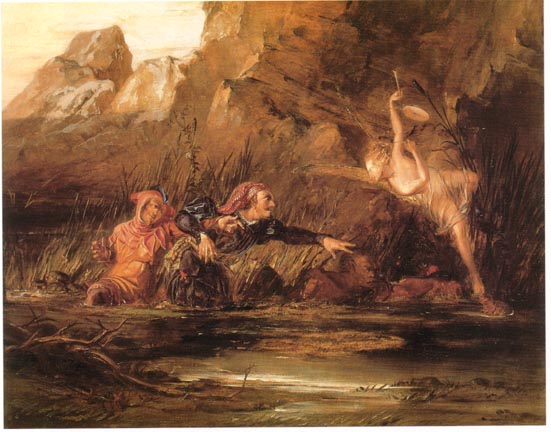
Caliban Upon Setebos

Natural Theology of the Island

“Thou thoughtest that I was altogether such a one as thyself.”
(David, Psalms 50.21)

[‘Will sprawl, now that the heat of day is best,
Flat on his belly in the pit’s much mire,
With elbows wide, fists clenched to prop his chin.
And, while he kicks both feet in the cool slush,
And feels about his spine small eft-things course,
Run in and out each arm, and make him laugh:

And while above his head a pompion-plant,
Coating the cave-top as a brow its eye,

Creeps down to touch and tickle hair and beard,
And now a flower drops with a bee inside,
And now a fruit to snap at, catch and crunch,—
He looks out o’er yon sea which sunbeams cross

And recross till they weave a spider-web
(Meshes of fire, some great fish breaks at times)
And talks to his own self, howe’er he please,
Touching that other, whom his dam called God.

Excerpt above. Link to full poem: https://www.poetryfoundation.org/poems/43748/caliban-upon-setebos

Robert Browning’s “Caliban Upon Setebos” begins with a bible verse. Specifically, one where God criticizes wicked people for thinking Himself wicked like they are. Browning’s Caliban, the speaker of this poem, seems to make the same claim that he too is different from how he is perceived to be – different from what Setebos, Caliban’s god, may think, but also different from who Prospero thinks he is.

Browning’s Caliban, like Shakespeare’s, depicts several contrasting characteristics. His pose in the beginning of this poem is rather childlike – lying on his stomach, kicking his legs up and down. He even refers to himself in the third person throughout the piece. Yet, his thoughts are surprisingly complex. He is considering his creator, Setebos, theorizing about the ways in which Setebos operates and how he himself should respond. As the secondary title of this poem suggests, Caliban is pondering theology, a topic rather at odds with his child-like posture.

What continues to surprise me in this poem is also how Caliban can think simply at times and yet be deeply observant. For instance, he dances only at night, so Setebos won’t be able to see him be happy, lest Setebos choose to bring misery to him. Caliban has a sort of wicked satisfaction in his own cleverness, but reveals himself to actually be deeply attuned to life on the island through his beautiful descriptions of it:

Yon otter, sleek-wet, black, lithe as a leech;
Yon auk, one fire-eye in a ball of foam,
That floats and feeds;

The contrasting character of Browning’s Caliban is carefully depicted in the form of a poem that Browning has Caliban himself deliver. And like Shakespeare’s Caliban, this evokes the image of a character that is sometimes strange and “other”, but perhaps much more sensitive and astute than he is given credit for. Only through his poetry do we see that perhaps he is more than he is thought to be.

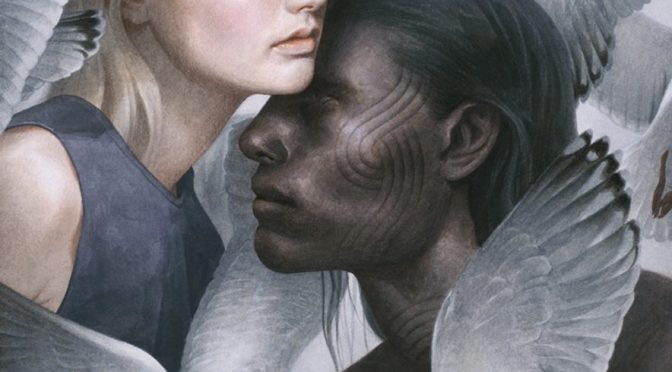
Book Cover with Caliban

From novel Miranda and Caliban by Jacqueline Carey

Book Description

We all know the tale of Prospero’s quest for revenge, but what of Miranda? Or Caliban, the so-called savage Prospero chained to his will?

In this incredible retelling of the fantastical tale, Jacqueline Carey shows readers the other side of the coin―the dutiful and tenderhearted Miranda, who loves her father but is terribly lonely. And Caliban, the strange and feral boy Prospero has bewitched to serve him. The two find solace and companionship in each other as Prospero weaves his magic and dreams of revenge.

Link to novel: https://www.goodreads.com/book/show/25670396-miranda-and-caliban

Fittingly for a visual representation on a YA romance novel, the beauty, or “poetry”, of this Caliban is in his face. This illustration of Caliban is pointedly different from the other two images of Caliban by Buchel and Mortimer. In those portrayals, Caliban is depicted as a decidedly non-human creature who has a compelling expression befitting of humanity. Here, Caliban seems to be completely human physically – with facial carvings that only slightly set him apart as “other.”

Jacqueline Carey’s Caliban is mutually in love with this story’s Miranda, and we are told immediately in the book’s summary that Caliban is a “so-called savage.” In tangent with his good looks on the cover and that self-aware “so called” title, I can assume that this Caliban is explicitly considered misunderstood, rather than subtly so like with Shakespeare’s Caliban.

However, while his outer appearance (on the cover art) might seem human, his manner is said to be “feral” and “strange.” Ironically, Shakespeare’s Caliban is able to outwardly express the poetry that marks him as a sympathetic man despite his (we are told) monstrous appearance, while Carey’s Caliban looks rather normal on the outside, but is suggested to act externally different. While Shakespeare’s Caliban is perceived to be monstrous, but perhaps underneath his exterior, is quite human, Carey’s Caliban is more like a human who is, wrongfully, perceived to be monstrous.

Caliban in The Tempest (2010)

The Tempest (2010) directed by Julie Taymor

Djimon Hounsou plays Caliban in this film adaptation of The Tempest. I chose this performance clip because nothing is said here, yet Hounsou’s Caliban manages to convey the human sensitivity with monstrousness that Shakespeare’s Caliban calls for us to examine.

Caliban’s appearance in this clip is clearly human in figure, yet he is also marked with scarring, discolorations and a nakedness that make him stand out as “other.” Prospera, played by Helen Mirren, is pristine and immaculate in comparison with her flawless skin and tailored outfit. She clearly holds power over this comparatively monstrous Caliban, as he stands still while she quickly approaches. And yet, when she sees his eyes bloodshot with tears, she seems to also realize, and examine, the sort of monstrous power that she has over him. In Caliban’s tears lie his humanity – his poetry, so to speak – which points out where Prospera’s own humanity may be lacking.

This depiction of Caliban is similar to the illustrations created by Mortimer and Buchel, who both demonstrated Caliban’s humanity through his fear. And while his fear might subject him to Prospera, that same human-like fear also subverts Prospera’s understanding of him as a savage. He is not all she believes him to be. There is something quite beautiful about the ending scene of the clip, where Caliban walks off by himself and is shot alone and above Prospera. He stands by the doors, pauses, then walks out. For once, it seems that he is seen as himself and is thus in control of himself.

Sketch of Herbert Beerbohm Tree as Caliban

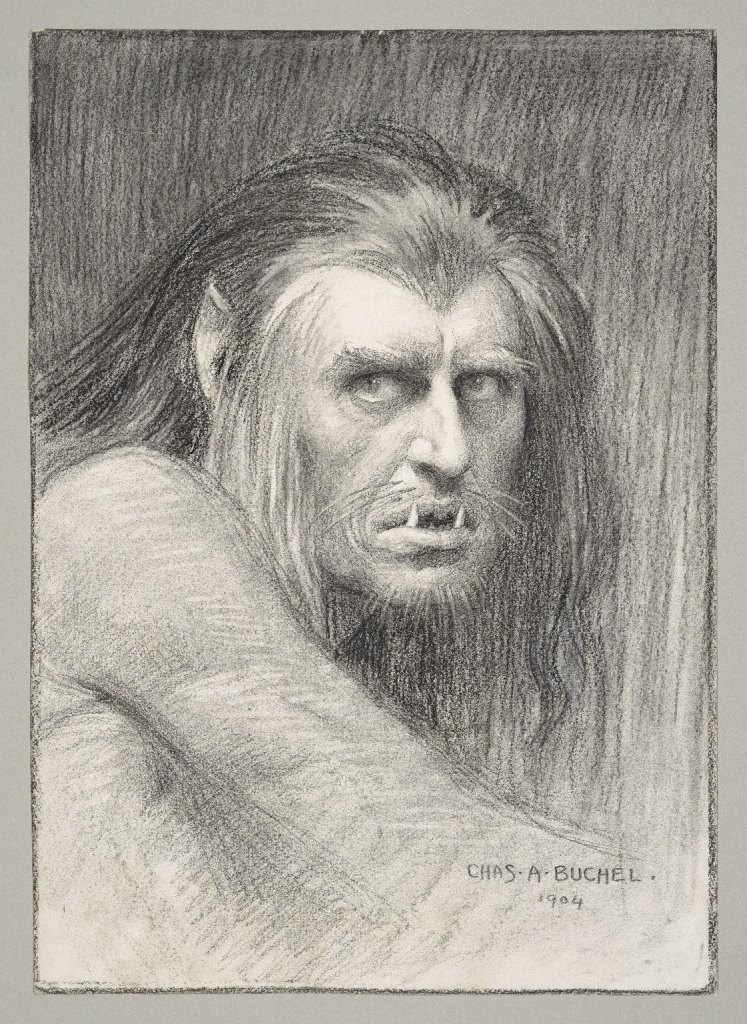
By Charles A Buchel (1904)

This sketch of Caliban, inspired by actor Herbert Beerbohm Tree’s Caliban costume, is utterly beautiful. I believe it delicately captures the contrast of Caliban: the monstrosity of him that leads other to remark on his appearance and demeanor, with the human intelligence and sensitivity that causes him to break out in poetry.

Buchel’s Caliban looks physically imposing with his sharp teeth, long whiskers, and pointed ears. He is clearly not quite human and would even be scary were it not for his eyes and expression. Buchel’s Caliban, though monstrous seeming, looks fearful. His eyes look intense and intelligent. Given his physical appearance, I want to ask what he could possibly be afraid of. Or perhaps, who could he be afraid of? Context tells me that he is likely looking at Prospero. And if that is the case, I begin to question – then who is really the monster?

The deeply articulate expression on the face of what seems to be a physically intimidating non-human reminds me of how beautiful verbal expression comes from the debased Caliban in The Tempest. Both characterizations of the two Calibans indicate that there is more to these characters than might initially be seen, of which is far more humane and sympathetic than the characters of The Tempest may believe. The poetry lies in the mind behind the appearance.

Etching of Caliban

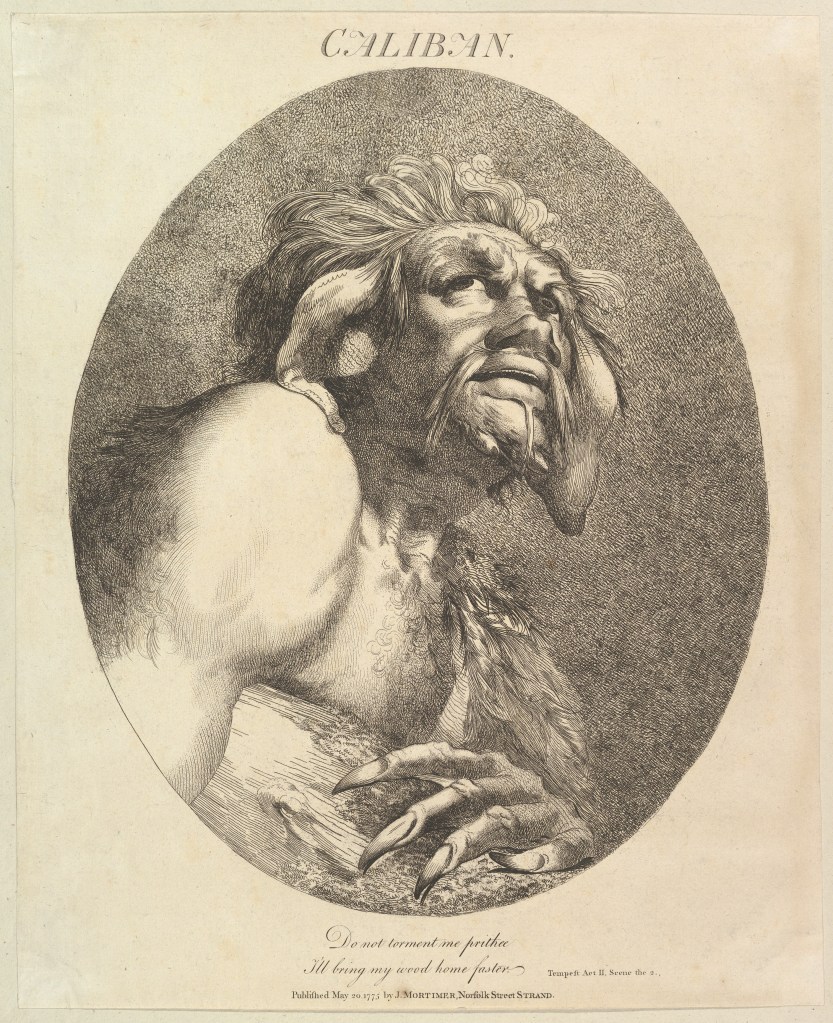
Etched and published by John Hamilton Mortimer (May 20, 1775)

“Do not torment me prithee
I’ll bring my wood home faster.”

(The Tempest, act 2, scene 2)

This is a beautiful image of Caliban that poignantly relays a message rather similar to the one that Buchel’s Caliban raises.

Similarly to Buchel’s Calban, Mortimer’s Caliban looks less than human. He is faun-like, a creature that I would expect out of mythology. He has the big droopy ears and long clawed fingernails. His right shoulder seems to be covered in hair, or even feathers. Yet, his torso and human expression are so human in their fear, they elicit sympathy.

I would suggest that the goal of this etch was to create sympathy for Caliban. The quote underneath his image makes the objective blatant, as it is a plea to not torment Caliban. This is again aimed toward Prospero, and the way that Caliban’s body is stopped, with his clawed hand held toward his body and curled in, denotes real fear. He is not intimidating or savage. He is a non-human, yes, but one deserving of sympathy. The poetry in this Caliban lies in the human expression on an otherwise non-human creature, one who is being hurt by someone he feels is more powerful than himself. If Buchel’s Caliban raised the question for me if Caliban was truly a monster, then Mortimer’s Caliban seems to answer that question. He is not a monster. He is not a human, but he is also not monstrous.

Caliban Dancing in Prospero’s Books

Film Prospero’s Books (1991) directed by Peter Greenaway

Michael Clark plays Caliban in this film version of The Tempest. Caliban in this film is a highly interesting figure, full of the sharp contrasts that Shakespeare’s Caliban conveys. Physically, Clark’s Caliban is nude with a mixmatch of reddish shades on his skin. His body is almost always contorted, and we are introduced to him as he presumably defecates on, urinates on and otherwise defiles Prospero’s books. He is a rather grotesque figure.

Yet, just as no other character speaks such beautiful poetry as Shakespeare’s Caliban does, no other character dances like Clark’s Caliban. His movements are beautiful and intricate, a sort of combination of ballet and contemporary dance. He is both alarming and captivating to watch, someone who turns you away yet compels you to keep looking.

There is something about his dancing body that only he has access to, which no one else can likely fully understand. To me, Clark’s Caliban physically illustrates the sharp contrast between the monstrous and the poetic is audibly heard from Shakespeare’s Caliban. I wonder, how can someone considered so “savage” express himself and his body so beautifully and articulately? Like Shakespeare’s Caliban, this Caliban’s form of “poetry” makes me question who he really is versus who he is perceived to be.

Caliban in a Tempest

Adapted from Une Tempête (1969) by Aimé Césaire

Quote found around 32:05 mark

Caliban: Call me X. That would be best. Like a man without a name, or to be more precise, a man whose name has been stolen. You talk about history well, that’s history, and everyone knows it! Every time you call me it reminds me of a basic fact, the fact that you’ve stolen everything from me, even my identity! Uhuru!

In Aimé Césaire’s a Tempest, Caliban is an angry, revolutionary figure. While perhaps in the 2010 film adaption of The Tempest, Caliban’s fear of Prospera leads to her understanding of him and his freedom, in Cesaire’s adaption, Caliban seeks for his freedom by wresting it from Prospero.

The wrestling can be seen immediately as Caliban begins the lines I have shared above. Not only does he demand that Prospero give him a name that he has made for himself, but he blatantly accuses Prospero of colonialism and ends with a loud proclamation of “Uhuru”, which is a Swahili word meaning “freedom.” His body language matches his words completely; he literally grabs the gun (a symbol of power) from Prospero, and corners him to the floor as he makes his statement. This Caliban is not one to be messed with. He knows what he wants and he will fight for it.

I thought this depiction of Caliban was interesting in its connection to the previous monstrous/poetic aspects of the different Calibans that I have brought up before. In this scene, Caliban might not be speaking poetry, but I find his cry of “Uhuru” to be a symbol of the “poetry” I have noticed in the Calibans before. Like when Shakespeare’s Caliban speaks poetry, assumptions about the monster he is thought to be are examined, when Cesaire’s Caliban says “Uhuru”, he calls forth a whole history of peoples who have been taken from their land and yet have an identity of their own. He becomes more than just one man against another, but he suggests a larger system of oppression. Caliban’s poetry always served to emphasize his humanity, and “Uhuru” does just that as one man, and a history of many, have called out for their freedom.

Caliban in a Novel

Prospero’s Daughter by Elizabeth Nunez

“To walk silently

in the forest,

and not shake a leaf, to move

and not disturb a branch.

At twilight

let me walk—

to the drum of impending

rest, caught between sleeping and waking— 

when rocks turn

malleable in the growing night, softening

to the touch of deepening

shade” (Nunez, 208).

Link to novel: https://www.goodreads.com/book/show/181435.Prospero_s_Daughter

Prospero’s Daughter is an adaptation of The Tempest set on a Caribbean island. In this novel, Prospero, or Peter Gardner, is the powerful and cruel colonial figure, while both Virginia (Miranda) and Carlos (Caliban) are oppressed by him. They eventually fall in love and have to confront Peter and systems of race, power and colonialism.

The excerpt above is written by the Caliban of this story, Carlos. Like Shakespeare’s Caliban, he literally creates poetry, and both of their poems are directly intertwined with the love of their islands. But while Caliban is a contrasting, ambiguous character, Carlos is the unequivocal hero of this story.

Nunez’s Caliban is a proud and intelligent one. Because of his biracial status (half black, half white) many characters undermine him (the story is set during the 1960s, drawing on colonial tensions between Britain and Trinidad). Yet, Carlos constantly exceeds the expectations of those around him. The ones who do think him inferior (like Peter) are revealed to be morally corrupt. Characters associated with goodness, like Virginia, don’t underestimate Carlos or see him as different. And everyone largely agrees that Carlos is handsome and rather intelligent, despite his background. Through this characterization then, Nunez explicitly tells the reader that racism, classism and colonialism are what make Carlos seem to be savage. He is not “savage” of his own self. There is no ambiguity in how Nunez interprets this Caliban character: he is noble.


Crania Americana

From Safiya Sinclair’s Cannibal

The Caucasian skull is large and oval, with well-proportioned features. The
nasal bones are arched, the chin full, the teeth vertical. This race is distinguished
for the facility with which it attains the highest intellectual endowments.

                                               Lusus Naturae
                                                        noun (rare)
                                                        A freak of nature.

Black body burns itself
                        to bushfire—
spurned husk that I am. Skinned viscous,
daughtering fever. Grief knifes its slow lava

through my fluorescent

Full poem here: https://lemonhound.com/2017/10/05/safiya-sinclair-from-cannibal/

Safiya Sinclair’s “Crania Americana”, from her larger work Cannibal, takes the form of a poem that her Caliban character delivers, but what particularly distinguishes this poem is how angry Caliban is throughout it. This Caliban demands to be heard loudly and clearly, reminiscent of Aime Cesaire’s Caliban.

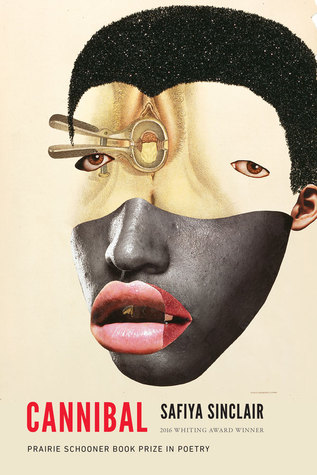
Sinclair clearly critiques colonialism through her (feminized) Caliban avatar. At first, Sinclair’s Caliban begins with a sarcastic opening on the aesthetic and intelligence of the white race, whose entire appearance is remarkably different from the black person on the cover of Sinclair’s novel. Perhaps the book cover character is a representation of Caliban, a symbol of a black man who has been perceived as other or savage because his features (and therefore “intellectual endowments”) are everything that a Caucasian’s is not. The next line speaks to this, as the black body burns and is considered a “spurned husk.”

The implication of physical description affecting intellectual capability correlates well with Shakespeare’s Caliban, who had to be taught how to speak by Prospero and Miranda, and is also given some of the most visually jarring descriptions (the “half fish, half monster” one also appears in the “Crania Americana” poem).

And yet, like Shakespeare’s Caliban, Sinclair’s challenges those very perceptions that others have on him (her) through intricate words of poetry. And as Sinclair’s Caliban angrily roars against colonial assumptions and expectations, I am reminded of Caliban in The Tempest when he says: “You taught me language, and my profit on ’t/Is I know how to curse” (I.II.368).

Design a site like this with WordPress.com
Get started